Sky This Month: January 2024
Sky This Month: January 2024
The new year begins with Jupiter and Saturn visible most of the evening. Uranus and Neptune are on show as well, requiring optical aid to spot. Meanwhile Mercury, Venus, and Mars congregate in the morning sky, with Mercury and Mars reaching a close conjunction. Also don’t miss the occultation of Antares, visible from portions of the mountain states and southern California. Add the potential for some binocular comets, and 2024 is off to a great start.
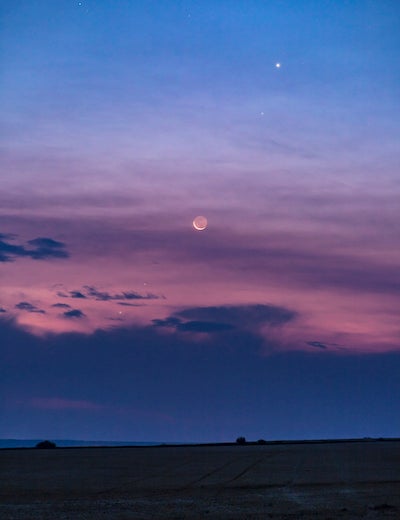
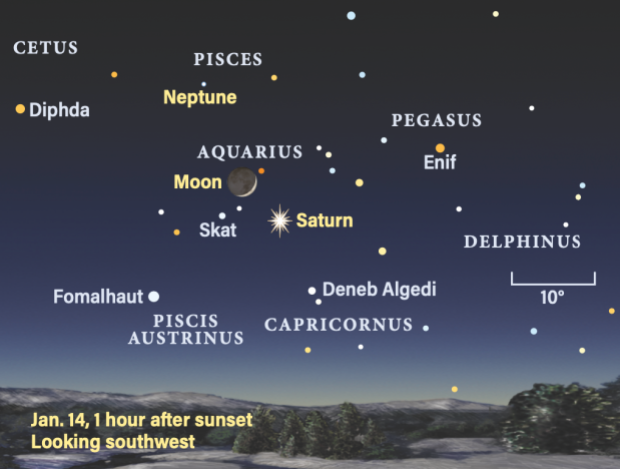
You’ll find Saturn glowing 30° high in the southwestern sky an hour after sunset. It lies in the constellation Aquarius, shining at magnitude 0.9. The bright star Fomalhaut — slightly fainter at magnitude 1.2 — lies 19° to its south-southeast. A beautiful thin crescent Moon stands 8° west and then 7° east of Saturn on the 13th and 14th, respectively.
Catch Saturn through your telescope early in the evening before it gets too low. It sets by 9 p.m. local time on Jan. 1 and is gone before 7:30 p.m. on Jan. 31. Your best view of the narrowing rings will be as soon as you pick the planet up out of the darkening twilight. After an hour you will quickly lose Saturn in the haze.
Your scope will reveal the planet’s disk, spanning nearly 16″ on Jan. 1. It shaves off almost 1″ by Jan. 31, as the distance to Saturn increases. The rings are tilted by 9° to our line of sight, providing a stunning view.
Get your last views of Titan before the planet moves into conjunction with the Sun. You’ll find Saturn’s brightest moon shining at magnitude 8.8. It stands roughly north of the planet Jan. 13 and 29 and roughly south Jan. 5 and 21. Three more moons, easily spotted in small telescopes, flit around the planet inside the orbit of Titan. Tethys, Dione, and Rhea shine at magnitude 10. Their constantly changing locations are fascinating to follow from night to night.
Early on the evening of Jan. 10, observers might spot tiny Tethys transiting the disk of Saturn shortly after 7:20 p.m. CST. Its shadow follows about 15 minutes after the moon begins its transit. This transit is best observed from the Midwest to Pacific Coast. For the eastern half of the country, a second Tethys transit is visible early in the evening on Jan. 12, beginning just before 5:40 p.m. EST.
Iapetus reaches its fainter (near 12th magnitude) eastern elongation Jan. 6, when its darker hemisphere faces earthward. Its orbit carries it closer to Saturn until Jan. 26, when it reaches inferior conjunction 27″ north of the disk. It’s a great time to spot this enigmatic moon, which should be glowing near 11th magnitude.

Comments
Post a Comment